
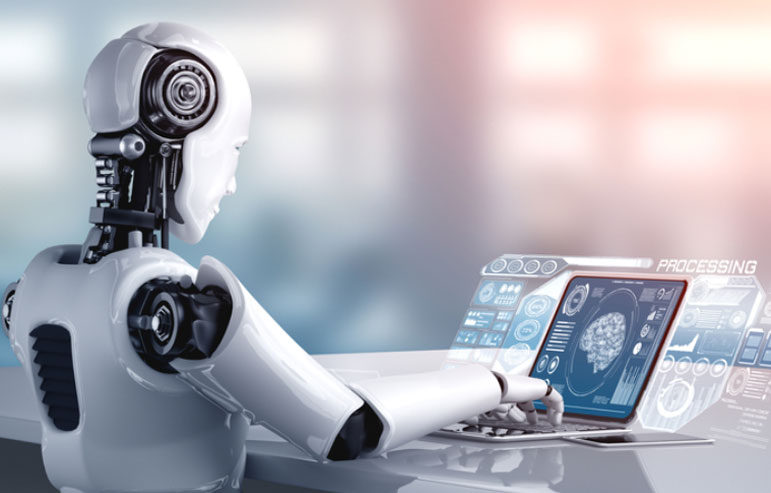
Movie you’ll love next, or a car can drive itself? The answer is artificial intelligence (AI).
Far from being science fiction, or limited to just the chatbots we know and enjoy, AI is part of our daily lives in countless ways. It is one of the most driving technologies of the time today, it is the engine of modern innovation. So what is the meaning of the “Artificial Intelligence”?
What is Artificial Intelligence (AI)?
Artificial intelligence (AI) is a group of technologies that enable computers to learn and reason, and to carry out many highly complex tasks, including handling language and information, and even making useful suggestions. It is a technology of change that can impact lives and societies in positive and meaningful ways, and the world.
It touches upon numerous fields such as computer science, data analytics and statistics, hardware and software engineering, linguistics, neuroscience and even philosophy and psychology.
AI is the technology that’s designed to make computers do the things that we can do: understand the world that surrounds them, learn new things, and even generate new ideas. For example, AI can be applied to Optical Character Recognition (OCR) to extract text and data from different images and documents. This process will convert unstructured content into structured, business-ready data, which will help you discover valuable insights.
How does AI work?
While there is a variety of AI techniques, they all rely on data, algorithms, and computing power. The more data an AI system receives, the more it learns and the better it gets.The larger the amount of data an AI system processes the more it learns and the more relationships and patterns it picks up that humans might not. This data is used for training the AI and the amount and quality of this data are critical to the performance of the AI.
As stated above, AI is not a single technology, but a large domain of several main components:
Machine Learning (ML): Refers to AI systems that learn from data to recognize patterns and make predictions or decisions without being explicitly programmed. Suppose that you want to teach a computer to identify a bird by presenting thousands of images of birds to it, then it learns how a bird looks by itself.
Deep Learning (DL): Deep Learning is a subset of ML which involves using an artificial neural network with several layers of neurons to learn from data, which is why it is called “deep. They are based on the structure of the human brain and are especially useful for more complex tasks such as image and speech recognition.
Natural Language Processing (NLP): NLP allows computers to comprehend, process and create human language. Voice assistants such as Siri and Alexa, translation and chatbots all rely on this.
Computer Vision: This is an aspect of computer science that enables computers to “see” and understand visual data from the world, including pictures and videos. It is used in facial recognition, self-driving cars, and more.
Want to learn how to get started with AI? Enroll in the free introductory course to Generative AI for Beginners.
Types of Artificial Intelligence
There are a number of different ways in which AI can be structured, based on the level of development or the activities undertaken.
AI Types of Capability
The classification is a way to categorize AI models according to their level of intelligence and problem-solving capabilities.
Artificial Narrow Intelligence (ANI): It is the current only form of AI. ANI models are intended for a particular purpose like spotting photos, talking with chat service or sorting e-mail. These can include voice assistants, facial recognition, and generative AI models such as Gemini and other large language models (LLMs). Even though the name ANI seems to imply that, ANI has no reasoning or self-awareness; it uses data and an algorithm to predict inside the boundaries. ANI has many merits, but it also has its drawbacks, such as providing biased or inaccurate results if the training data is flawed, which can be especially problematic in contexts like loan applications, recruitment, and predictive policing. ANI can also be used by cybercriminals in the development of more complex scams using AI.
Artificial General Intelligence (AGI): These are opportunities for what AI might become in the future. Ideally, AGI would be able to perform a wide variety of tasks and would employ human-like reasoning in order to learn, adapt, and improve. As of now, AGI is not a reality. Unlike ANI, AGI should be adaptive, autonomous, and learn from its actions. Examples of fictional objects are a droid from the Star Wars universe. The potential for limitless destructive power isn’t all that noteworthy, however, because there are quite a few safety and moral concerns with AGI, the malicious actors could build AGI with harmful intent.
Artificial Superintelligence (ASI): This is the most advanced theoretical form of Artificial Intelligence. If ASI were to come into existence, it would be a self-aware entity that is not controlled by humans and would have much greater intelligence than humans in terms of reasoning, creativity, emotional intelligence, and more. As with other forms of AI, there is fear that ASI, too, could threaten humanity and some AI researchers believe that the likelihood of very bad outcomes is not negligible, with some predicting human extinction.
AI is capable of typing by function
The classification represents different categories of AI, depending on how it is used and how it works in particular contexts.
Reactive machines: Artificial intelligence machines that respond to various types of input, according to preprogrammed rules. It has no memory and thus is unable to learn from new information. One such instance is IBM’s Deep Blue, which beat chess Grandmaster Garry Kasparov in 1997.
Limited memory: Most modern AI is limited memory. It can learn over time by applying memory of new data, which is normally done by training an artificial neural network or other training model. This kind of memory will be short-term; once the session is over, the memory can reset. Examples include self-driving cars observing other vehicles and chatbots like Gemini remembering previous messages in a conversation.
Theory of mind: Theory of mind AI does not yet exist (but is being studied). AI that can imitate the human mind and make decisions like a human, such as identifying and recalling emotions and acting in social settings like a human.
AI in action: Changing our world
AI is making an impact that is both significant and far-reaching, spanning almost every facet of life and industry. This is where it is helping and making a difference:
- In everyday life: AI is used in the virtual assistants on smartphones, in personalized recommendations for streaming services, in spam filters for email, and in navigation apps such as Google Maps.
- AI is transforming healthcare: Enabling physicians to make earlier diagnoses by examining medical images, to tailor treatments to individual patients, and to speed up the drug discovery process by a lot.
- Navigation, real-time decision-making, and object detection: AI helps autonomous vehicles navigate, make decisions, and react quickly.
- Customer Service Chatbots: AI can power customer service chatbots that respond to inquiries and guide customers through their service experiences.Fraud Detection: In finance, AI can be employed to detect fraudulent transactions.Supply Chain Optimization: AI can help businesses optimize their supply chains.
- Entertainment: AI can generate more believable and challenging characters in video games. Generative AI can now create music, scripts, and create and generate amazing visual art in content creation.
The History of AI
The concept of machines that can think for themselves isn’t new. Concepts of artificial beings with intelligence stretch back decades; however, the modern field of AI truly began to take shape in the mid-20th century. Let’s now explore the history of AI as a whole:
- Seeds of AI – the 1940s-1950s (programmable computers): Imagination was sparked with the invention of programmable computers in the 1940s. Alan Turing came up with the “Turing Test” in 1950 to check the possibility of machines displaying intelligent behavior that is indistinguishable from a human being. This was a very important philosophical and scientific move.
- Consider this the official birth of AI as an academic field: The Dartmouth Summer Research Project, organized by pioneers such as John McCarthy. The term “artificial intelligence” was coined here.
- Early successes (1960s-1970s): The creation of the first AI programs, such as ELIZA, the chatbot that could engage in simulated conversations, and Shakey the Robot, the first robot to reason about its environment. But the process of building true intelligence saw the funding and progress slow, especially during the years known as “AI Winters.
- Revival and Growth (1980s-2000s): The development of expert systems and later, the rise of machine learning, breathed new life into AI research. AI’s capabilities were demonstrated in 1997 by the IBM Deep Blue defeating a chess grandmaster.
- The Modern AI Boom (2010s to Present): Recent developments in the field of AI, particularly in the wake of the rapid advancement of computing power, the accessibility of large-scale datasets, and the breakthroughs in deep learning, specifically neural networks, have propelled the current era of the AI revolution. During this time, some extremely strong tools have been developed that are changing industries.
The Cutting Edge: Generative AI, LLMs, and the emergence of AI agents
The most thrilling developments in the field of AI in recent years have been generative AI and large language models (LLMs). But the frontier is moving quickly, with the rise of AI agents and agentic AI, both of which are an important step towards more autonomous and capable AI systems.
Generative AI: This is a type of AI that does not only analyze data; it generates new content. Consider it an AI artist, writer, or even coder. Generative AI discovers patterns and structures in huge volumes of data, from text to images, code to more, and leverages this learning to create entirely new and original content based on prompts. Examples of such tools include image generation software such as DALL-E and text generation software like ChatGPT.
Large Language Models (LLMs): These are the set of models behind many of the most advanced uses of AI today, particularly in the context of text generation. LLMs are large AI models that are trained using large volumes of text and code. They are good at comprehending, creating and working with human language. They have been exposed to a lot of information and can answer complex questions, summarise documents, translate languages, write creative text and even create computer code. These models are getting more and more capable and can even begin to generate “emergent abilities” such as solving math problems and creating code, but it’s always a good idea for developers to review and validate code generated by AI. LLMs are also being made multimodal, that is able to comprehend and process not only text but also images, audio, and video.
- AI agents: These are AI systems that perceive, decide and act to accomplish a specific goal.
- An AI agent can: An AI agent is different from a basic chatbot that follows a command, as it can:
- Plan: Divide a big goal into a series of smaller, manageable tasks.
- Create arguments: Make a decision based on its knowledge and understanding at each stage
- Act: Interact with digital or even physical environments (via APIs or robotic interfaces), to execute its plan.
- Learn/Adapt: Can learn from its experiences and make adaptations to enhance its performance over time
- Agentic AI: This is the ability of an AI system to act independently as mentioned above.
This could be especially intriguing for software developers, as AI agents can be taught to communicate with software development tools, APIs, and even code bases. This paves the way for AI to take over more intricate development challenges, including automatically testing fresh features, refactoring extensive portions of code, or even overseeing project workflows. Current research is centered around improving the reliability, efficiency and safety of these agents as they become more autonomous.