
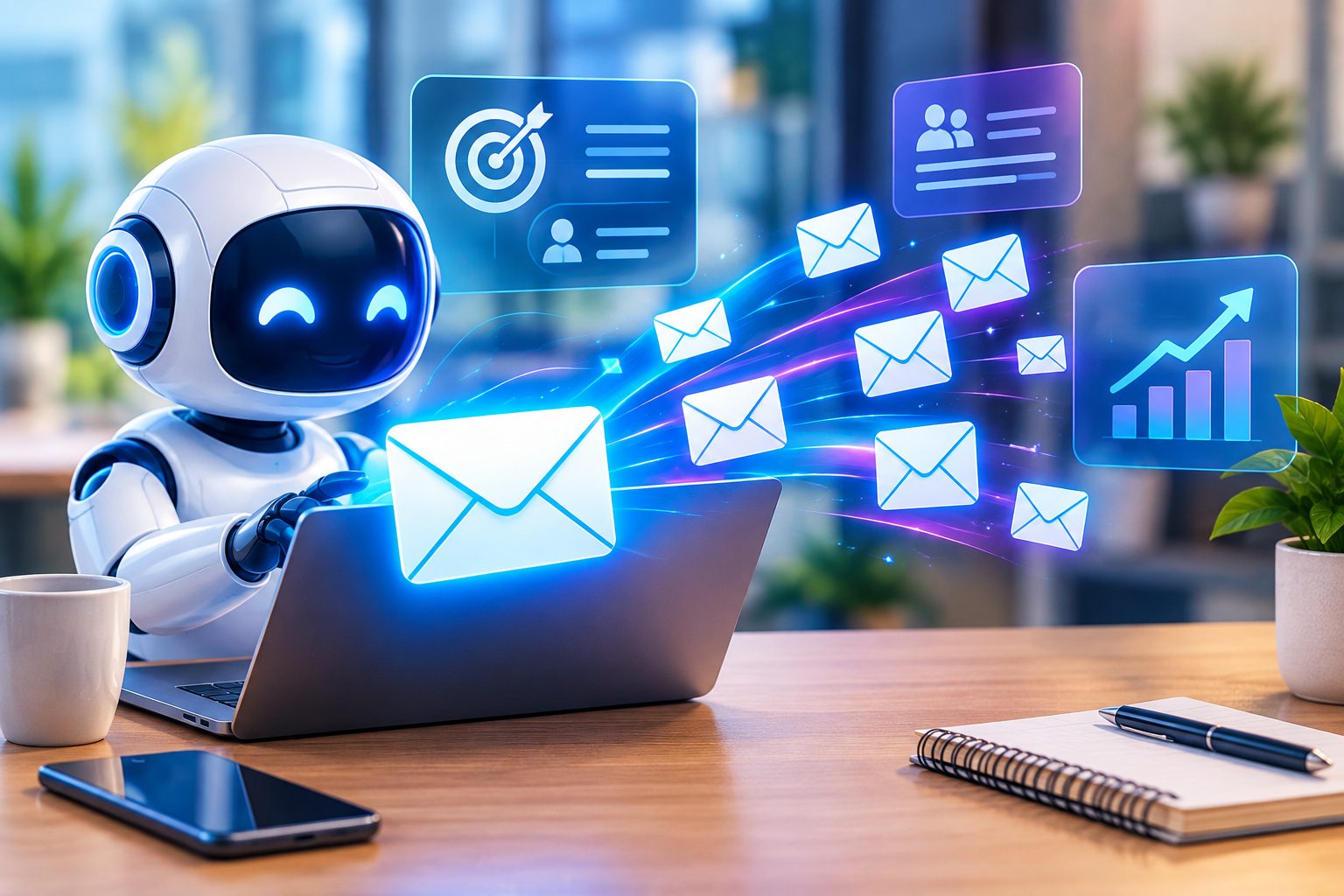
Digital marketing is ongoing and will keep on developing as organizations explore new technologies to concentrate on their clients, making better engagement and conversions. One of the most important trends of 2026 is the increasing role of artificial intelligence (AI) in email marketing. Gone is the era of generic e-mail marketing and in its place are intelligent systems that learn about customer behavior, personalize e-mail, automate communication and optimize marketing.
AI email marketing leverages machine learning, predictive analytics, natural language processing, and automation to deliver more personalized and impactful email marketing campaigns. Instead of sending a generic message to all subscribers, marketers can leverage AI-powered tools to send customized content that reflects each subscriber’s interests, preferences, and interactions.
With the rising competition in digital marketing, AI email marketing is gaining significant importance for businesses aiming to enhance customer relationships and foster long-term growth.
Understanding AI Email Marketing
AI email marketing involves leveraging AI tools for email campaign planning, creation, personalization, automation, and optimization. These technologies enable marketers to know their consumers and to send more personalized messages to individual subscribers.
Typical email marketing relies on segmenting customers and setting up campaign schedules that are made by hand. AI can process vast customer data and provide insights for marketers to make informed decisions.
An online shop, for instance, can leverage AI to suggest items reliant on customer browsing history and prior orders and preferences. A software firm can deliver instructive emails as per the features a subscriber has explored.
This helps create a more personalized email communication and enables businesses to provide relevant content at the right time.
Personalized Email Campaigns Through AI
Customization is a vital element of contemporary online marketing. Messages that resonate with the needs and interests of customers will be more likely to be interacted with.
AI takes personalization one step further by drawing on customer data to provide personalized recommendations. These insights can be leveraged by businesses to tailor email subject lines, product suggestions, promotional offers, and content.
AI-driven personalization may consist of:
- Product suggestions: Recommend products as user browses and has purchased in the past.
- Dynamic email content: Modifying email content to suit preferences of subscribers.
- After specific customer actions: Send emails – behavior-based messaging.
- Personalized offers: Giving relevant discounts and promotion.
- Consumer Segmentation: Subscribers categorised by their common interests and activities.
These functions enable companies to deliver more personalised communication, rather than generic marketing messages.
Email Marketing Automation powered by artificial intelligence
AI is also revolutionizing email marketing in terms of automation. Intelligent systems can be used to manage repetitive marketing activities and keep customers consistently informed.
Welcome emails, cart abandonment notifications, follow-up messaging, promotional campaigns, and customer re-engagement are all areas where AI-driven automation can help.
For instance, if customers add items to their online shopping carts and never check out, an automated email can be sent to remind them of the products. AI can assist in deciding when, what and what products to recommend.
There are several benefits to automated email workflows:
- Minimize repetitive marketing activities.
- Keep in touch with subscribers.
- Send out timely messages according to customer activity.
- Enhance organization and efficiency of campaigns.
- Help customers on a customised journey.
Automation and customer insights can work together to streamline business marketing processes.
Improving Email Content Creation With Generative AI
Email content creation has become quicker and more accessible with the advent of generative AI. AI writing tools can help marketers create subject lines, promotional offers, newsletters, product descriptions, and variations of campaigns.
These tools can be utilized by businesses to create content for various audience groups and marketing goals.
A new product rollout company might, for instance, generate several versions of their email message with AI that accentuate various advantages. These drafts can then be viewed by marketing teams, edited for the message, and the most appropriate one chosen.
AI content creation can assist marketers in the following ways:
- Craft out-of-the-box email subject lines.
- Compose emails for promotions.
- Develop variations of the message.
- Tailor the style, tone and form of content to target groups.
- Create ideas for newsletters and campaign concepts.
But, no AI-created content should be left unsupervised by a human. Marketers must make sure messages are accurate, relevant, clear and consistent with the brands voice.
Predictive Analytics and Smarter Campaign Decisions
Predictive analytics is now playing a more important role in the field of AI email marketing. It relies on historical data and statistical models to predict customer behavior in the future.
Predictive insights can help companies uncover subscribers that may be interested in a product, customers that are more likely to make another purchase, or people who may cease engaging with email campaigns.
These insights enable marketers to make informed decisions on campaign timing, audience targeting, and promotion strategies.
For instance, in a subscription business context, they could discover that customers have been less active in their subscription. It can then design a targeted email marketing campaign and provide information that is useful to the reader or even offers of interest, to spark renewed interest.
Businesses can transition from reactive marketing to pro-active customer communication with predictive analytics.
Ensuring that your Email Campaigns are Performing well
AI can help to analyze the results of email campaigns and find ways to improve them. Marketers can test various subject lines, content styles, calls to action, and timing of campaigns.
One of the usual ways to compare different changes to your email is A/B testing. AI can be leveraged to create variations of tests and to study performance patterns, helping marketing teams gain insight into what works best for certain audiences.
Key email marketing metrics are:
- Open rate: The percentage of emails opened, but this may be less accurate due to privacy settings.
- Click-through rate: Measured by the number of recipients who click links in an e-mail message.
- Unsubscribe rate: Indicates the number of users who unsubscribe from receiving future e-mails.
- Revenue per email: Helps evaluate the revenue generated by email campaigns.
It’s important for businesses to care more about engagement and conversion than one metric.
AI Email Marketing and Customer Experience
Customer experience is one of the key factors in the success of digital marketing. AI can be used to deliver more personalized messaging at various points in the customer journey.
Whether it’s with a welcome email or post-purchase communications, AI-driven systems can enable personalized interactions based on customer behavior.
For example, a customer just bought a laptop might be offered information about accessories, maintenance, or other related services. An interested subscriber to any of these services can be given educational material pertinent to the interests of the subscriber.
This can make it easier for customers to be satisfied with the email communication by making it more useful and less repetitive.
Challenges Businesses Should Consider
While AI email marketing can be incredibly beneficial, there is a need for responsible use.
It’s important to consider customer privacy, data security, email deliverability, and the accuracy of content. Companies should secure proper permission, adhere to relevant e-mail marketing laws, and offer easy unsubscribe alternatives.
AI systems could also generate false content or suggestions. Human involvement will still be essential to safeguard brand reputation and communication.
Any personalization that is too much should be avoided by businesses because it will make the subscribers uncomfortable. The aim is to give the customer positive experiences that are in line with their needs or preferences.
The Future of AI Email Marketing
Looking forward to 2026, AI email marketing is evolving with businesses delving deeper into advanced personalization, predictive customer insights, and intelligent automation.
These are all potential future enhancements to the platform, with greater sophistication in customer journey optimization, integration with customer relationship management platforms, and the use of AI agents for campaign management being possible additions.
By integrating AI features with strategic marketing approaches, companies can boost their efficiency and preserve genuine customer connections.
Conclusion
AI email marketing is revolutionizing digital marketing by empowering email campaigns to be more personalized, automated, data-driven, and effective. These technologies enable businesses to grasp customer preferences and provide targeted communication, ranging from creating AI-generated content to predictive analytics and smart campaign optimization.
But having the right technology is not enough to be a successful email marketer. Trust, quality content, privacy and clear marketing goals are important factors that businesses must put into focus.
In 2026 and beyond, AI can be used in conjunction with human creativity and strategic planning to help organizations establish deeper customer connections, enhance engagement, and develop more successful digital marketing campaigns.